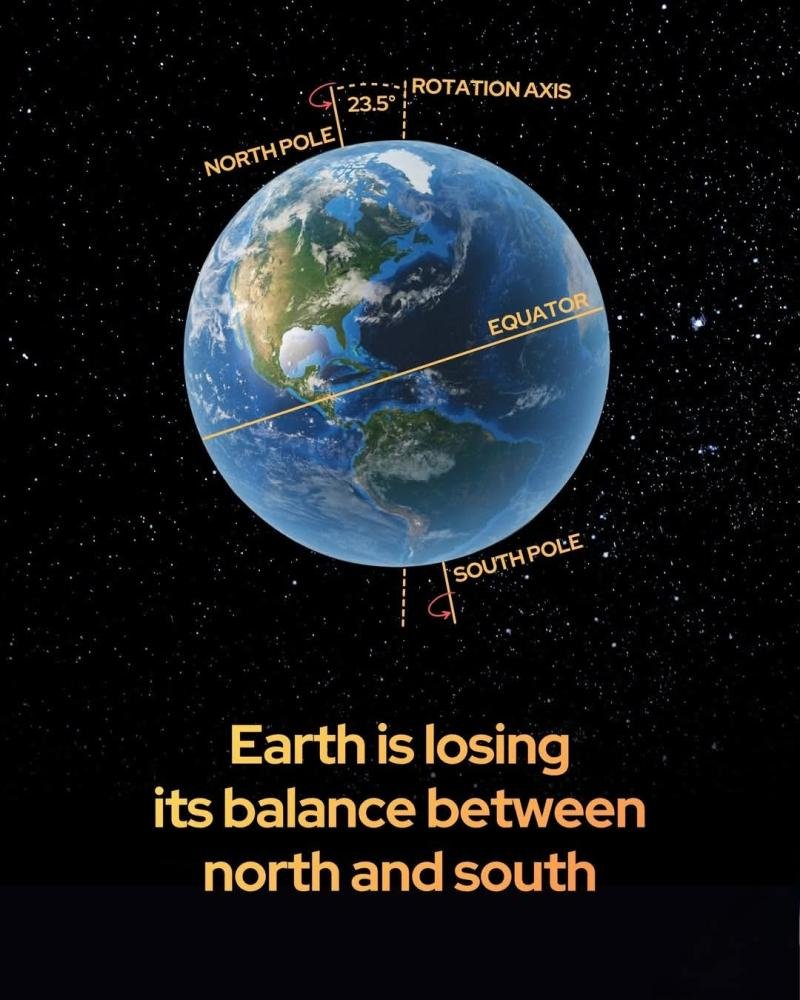
New research reveals the Northern Hemisphere is absorbing significantly more solar energy than the Southern Hemisphere, a shift that could reshape global weather patterns.
Since 2001, the Northern Hemisphere has been retaining approximately 0.34 watts more solar energy per square meter every decade compared to the South. This growing energy gap is driven by a combination of environmental changes that have fundamentally altered how our planet reflects sunlight. As snow and ice melt, they expose darker land and ocean surfaces that soak up heat rather than bouncing it back into space. At the same time, a decline in air pollution across the north has cleared the atmosphere of reflective aerosols, while rising water vapor levels further trap heat, creating a feedback loop of warming.
Perhaps the most startling discovery is that Earth’s natural cooling mechanisms are failing to keep pace. Scientists previously expected cloud cover to increase and offset this extra heat absorption, but recent data shows clouds are not stepping in to restore the balance. This discrepancy challenges existing climate models and suggests that the planet’s ability to self-regulate its energy may be more fragile than once thought. As this hemispheric divide widens, the resulting pressure could trigger significant shifts in rainfall patterns and storm tracks worldwide.
source: Proceedings of the National Academy of Sciences (2025). Emerging hemispheric asymmetry of Earth’s radiation. PNAS.