Tech (Articles: 17)

image
🚀 China just made a major move in the global quantum race!

The world’s first open-source quantum computer operating system, Origin Pilot, has been released and is now available for free download worldwide.

Developed by Origin Quantum to power their Wukong superconducting quantum chip, this OS is designed to manage complex quantum tasks, optimize qubits, and even integrate AI capabilities across different hardware platforms.

By going open-source, China is inviting global developers to collaborate, accelerating innovation and pushing toward technological self-reliance as outlined in the 14th Five-Year Plan.

🌐 Quantum computing just became a little more accessible. Check it out below!

#QuantumComputing #OriginPilot #TechNews #OpenSource #Innovation #ChinaTech #Wukong
🔐 Chrome is testing a new model of HTTPS
image
certifications in preparation for the post-quantum era.
In a proactive step against the risks of quantum computing, Google Chrome is testing what’s known as Merkle Tree Certificates (MTCs) — a radically different mechanism than the traditional X.509 certification model.
The problem is clear: Integrating post-quantum signature algorithms within the X.509 series will result in a significant boom in certificate volume, meaning a significant increase in TLS handshake data and a direct impact on performance.
The suggested solution is based on the structure of Merkle Tree:
Instead of the credentialing book signing each certificate individually, CA signs a single “tree head” covering millions of certificates at once. Upon calling, the browser gets a compact Merkle Proof that the certificate is listed inside the signed tree, without having to send a huge chain of signatures.
Technically this means:
TLS Handshake with Data.
Higher scalability when adopting Post-Quantum algorithms.
Improving auditability and transparency via a cryptically verifiable insertion model.
Switching to punch-resistant encryption won't be just an algorithm update... Rather re-engineering the entire trust system.
#cybersecurity #postquantum #cryptography #TLS #Chrome
Russia Fines Google an Astronomical “$20 Decillion” Over YouTube Channel Bans
image
A Russian court has ordered Google to pay what is being described as around 2 undecillion rubles — commonly reported as roughly $20 decillion — for failing to restore several pro-Kremlin YouTube channels that were blocked.

The dispute dates back to 2020 and intensified after Russia’s 2022 invasion of Ukraine, when YouTube removed or restricted multiple Russian state-affiliated media outlets. Russian broadcasters, including Tsargrad and RIA FAN, sued Google under Russian law, arguing the bans were unlawful.

Because the court imposed daily penalties for non-compliance that continued to accumulate, the total ballooned into a number far exceeding global GDP. Kremlin spokesperson Dmitry Peskov has described the fine as “symbolic,” signaling that the goal is political pressure rather than realistic financial recovery.

Google’s Russian subsidiary filed for bankruptcy in 2022, and the company has largely scaled back operations in the country. There is no indication the tech giant plans to pay the astronomical sum.

The case highlights the growing clash between global tech platforms and national governments over content control, censorship laws, and digital sovereignty.

#Russia #Google #YouTube #TechNews #DigitalSovereignty #UkraineWar #MediaPolicy #FreeSpeechDebate #GlobalPolitics #BigTech
image
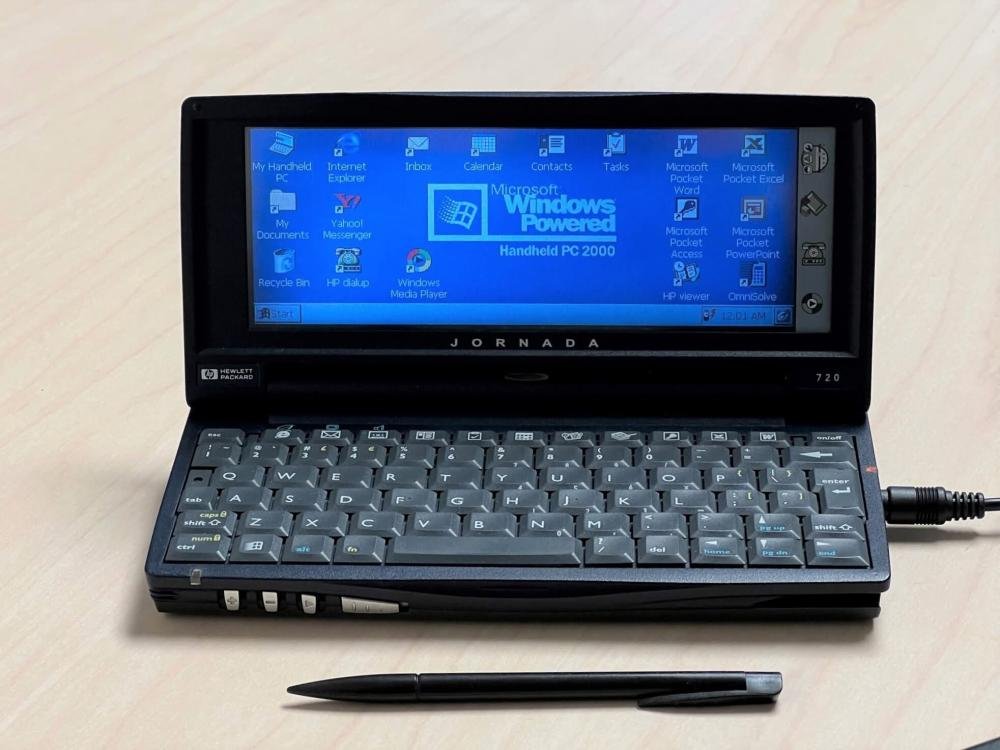
The HP Jornada 720 was one of the most advanced handheld PCs around the year 2000 — essentially a precursor to later keyboard-equipped smart devices, but with genuine PC-style capabilities.
In terms of hardware, the Jornada 720 runs on a 206 MHz 32-bit Intel StrongARM SA-1110 processor, paired with 32 MB of SDRAM and approximately 32 MB of ROM. For its time, this was a solid configuration, capable of running Windows CE (HPC2000) smoothly. The device measures roughly 189 × 95 × 34 mm and weighs about 510 gramsincluding the battery, giving it a sturdy, compact clamshell form factor.
The display is a 6.5-inch color screen with a resolution of 640 × 240 pixels and supports 16-bit color (65,536 colors). It features a touchscreen operated with a stylus, complemented by a comfortable three-quarter-size keyboard, which was one of its strongest advantages compared to many other PDAs of the era.
For connectivity, the Jornada 720 includes an integrated 56 kbps modem, IrDA infrared, an RS-232 serial port, and USB connectivity via a cradle. Expansion options consist of a CompactFlash (Type I) slot and a PC Card (Type II) slot. Additional features include a smart card slot, stereo speakers, a built-in microphone, and a 3.5 mm audio output jack.
Power comes from a removable lithium-ion battery, rated for up to 9 hours of use, which was impressive for a device in its class at the time.
🔒 A U.S. court has sentenced Oleksandr Didenko to five years in prison for running a massive identity theft operation that helped North Korean workers land jobs at dozens of American companies. Prosecutors say the wages earned were funneled back to Pyongyang Pyongyang to support its sanctioned nuclear program.

💻 According to the U.S. Department of Justice, Didenko operated a website called Upworksell, selling or renting 870 stolen U.S. identities to overseas workers. These identities allowed North Koreans to pose as legitimate remote employees and quietly infiltrate U.S. firms.

🚨 In 2024, the FBI seized the site and redirected its traffic to government servers. Polish authorities later arrested Didenko, who was extradited to the U.S. and pleaded guilty. He also paid Americans to host so called laptop farms, enabling foreign workers to remotely control computers located inside the United States.

📊 Security firm CrowdStrike has reported a sharp rise in these North Korean IT worker schemes, calling them a triple threat. Beyond violating sanctions, the operatives allegedly steal sensitive data and later attempt corporate extortion, while also impersonating recruiters and investors to target high value victims.
image
image
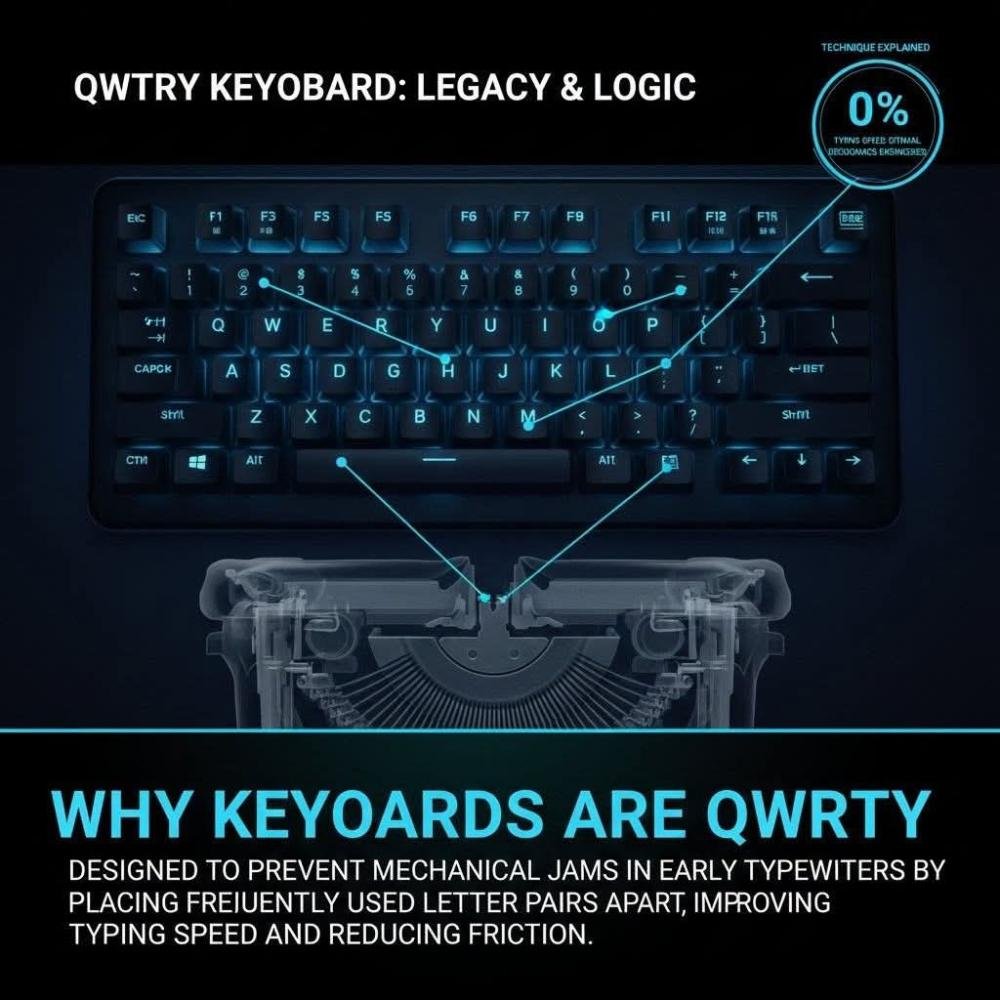
Ever wondered why the keyboard is not alphabetical?
It would seem logical.
A B C D E.
But QWERTY was never about logic.
It was about mechanics.
Here is what actually happened.
In the 1870s, early typewriters had mechanical arms called type bars. When two commonly paired letters were pressed quickly, the metal arms would collide and jam.
Frequent jams slowed typing and frustrated users.
So the layout was redesigned to separate commonly used letter pairs.
Letters that often appear together were spaced apart to reduce mechanical interference.
The result was the QWERTY layout, popularized by Christopher Latham Sholes and later adopted widely through Remington typewriters.
What started as a mechanical workaround became a global standard.
Even though modern keyboards no longer have type bars, the layout remained because:
• Millions learned it
• Schools taught it
• Businesses standardized around it
• Switching costs became too high
This is called path dependence.
A past solution shapes the future, even after the original problem disappears.
Today, billions type daily on a layout designed to prevent 19th century metal collisions.
Design decisions last longer than the problems they solve.
What everyday object should we decode next?
#Engineering #DesignHistory #Innovation
image
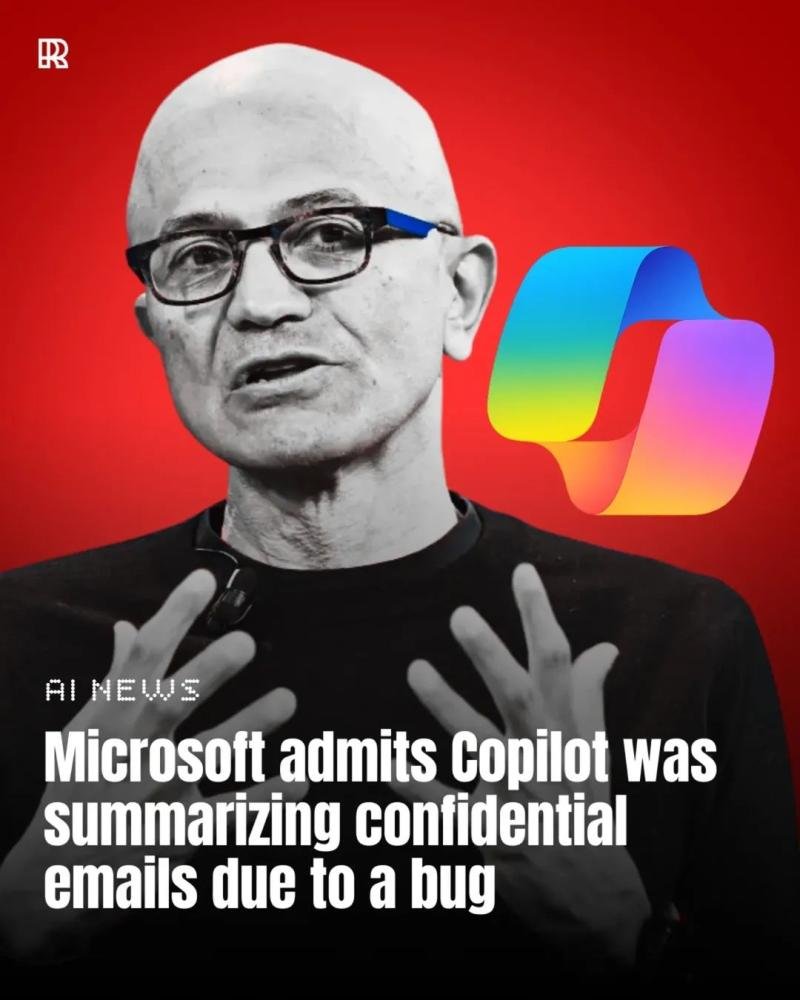
Microsoft has confirmed that a bug in Microsoft 365 allowed its Copilot AI to improperly access and summarize customers’ confidential emails for several weeks.

The issue, first reported by BleepingComputer and tracked internally as CW1226324, affected Copilot Chat within Office apps such as Word, Excel, and PowerPoint.

According to the company, emails stored in users’ Sent Items and Drafts folders, including those labeled confidential and protected by data loss prevention policies, were incorrectly processed by the AI system.

Microsoft said it began rolling out a fix earlier this month but has not disclosed how many customers were impacted.

Follow us (@therundownAI) to keep up with the latest news in tech and AI.

Source: TechCrunch
image
Hollywood is pushing back hard against Seedance 2.0,ByteDance’s new AI video tool that can generate realistic 15-second clips from just a text prompt.

The tool quickly went viral after one user generated a video of Tom Cruise fighting Brad Pitt with only a two-line prompt. Deadpool screenwriter Rhett Reese reacted, “It’s likely over for us.”

The Motion Picture Association slammed ByteDance for “massive unauthorized use of U.S. copyrighted works” and demanded they stop distributing Seedance 2.0.

Disney and Paramount also issued cease-and-desist letters after the AI generated videos featuring Spider-Man, Darth Vader, Grogu, and other iconic characters. SAG-AFTRA called it “blatant infringement” on actors’ likenesses.

ByteDance says it’s adding safeguards to block real people and celebrities, but critics argue the viral clips have already done the damage.

Seedance 2.0 is fueling a bigger debate: AI video tools could make filmmaking faster and more accessible but also threaten creative jobs, copyright protections, and the traditional Hollywood model.

#Seedance2 #AIvideo #ByteDance #Hollywood #AI
image
Most people think zipping a file is just “making it smaller.”
That is true, but the real story is more interesting.

Zipping is about compression and packaging.

First, compression.
When you zip files, the system looks for repeated patterns in the data.
Instead of storing the same information again and again, it stores it once and keeps a reference.
For example, if a document repeats the word “technology” 200 times, zip compression stores it once and says, “reuse this here, here, and here.”
That is why text files shrink a lot, while videos and images barely change since they are already compressed.

Second, packaging.
Zipping bundles multiple files and folders into a single archive.
This makes sharing, uploading, and backing up easier.
One file, one transfer, less chance of missing something.

What zipping does not do.
It does not delete data.
It does not reduce quality.
It does not encrypt your files by default, unless you add a password.

Why zipping matters in real life.
Faster uploads and downloads.
Smaller storage usage.
Cleaner file sharing, especially for projects with many folders.

In short.
Zipping files is smart data organization plus efficient compression.
Not magic. Just clever engineering that saves time and space.
image
According to a Microsoft report published in Technology Magazine, countries are ranked based on the percentage of the working-age population using AI services from various companies. The data is collected through telemetry from user devices, but changes in IP addresses can affect the accuracy of the measurements.

The United Arab Emirates took first place, with its user share increasing from 59.4% in the first half of the year to 64% in the second. It was followed by Singapore (58.6% → 60.9%), Norway (45.3% → 46.4%), Ireland (41.7% → 44.6%), and France (40.9% → 44%).

The most significant year-on-year growth was recorded in South Korea, which climbed seven spots. Nearly a third of the population (30.7%) now uses AI applications.

The Russian Federation ranks only 119th on the list. AI service penetration was 7.6% in the first half of the year and rose to just 8% in the second. Venezuela, Belarus, Kyrgyzstan, and Kenya ranked ahead of our country.

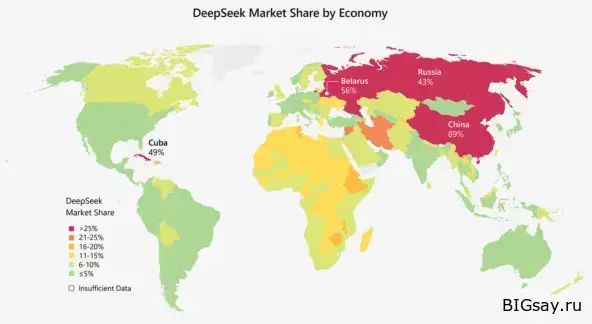
Additionally, the popularity of the Chinese chat service DeepSeek was studied separately. This service is most widespread in China (89%). In Russia, it is chosen by 43% of users, in Cuba by 49%, and in Belarus by 56%.
image
Tag Cloud / Authors