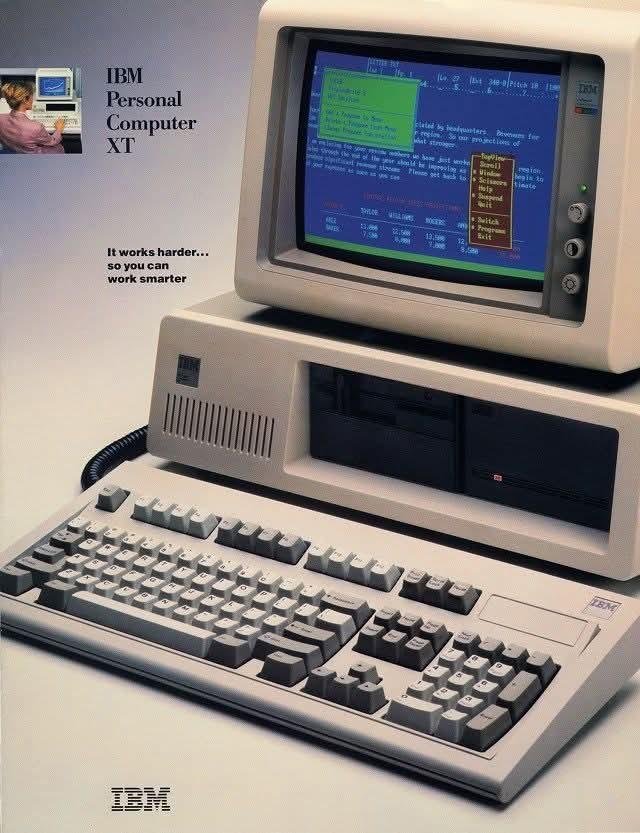
The IBM Personal Computer XT (model 5160), released on March 8, 1983, was the direct successor to the IBM PC (5150) and was mainly intended as a practical extension. Technically it remained largely identical, but with several important improvements.
The XT used an Intel 8088 CPU running at 4.77 MHz, with a standard 128 KB of RAM, expandable up to 640 KB on later motherboards. It included IBM BASIC (64 KB) in ROM and typically ran PC DOS 2.0. The most significant innovation was the built-in 10 MB hard disk (usually a full-height 5.25" drive with a Xebec controller), alongside one or two 360 KB floppy drives. Floppy-only models appeared only in later years.
The system offered 8 ISA expansion slots (instead of 5 in the original PC), although due to physical space limitations two of these could not accept full-length cards. An optional Intel 8087 math coprocessor could be installed to accelerate floating-point calculations.
The power supply delivered 130 watts (US models 120V, international versions also supported 240V). The desktop-style case measured approximately 50 × 41 × 14 cm and weighed about 15 kg. Graphics options ranged from MDA and CGA to EGA and PGA in later models.
A notable expansion was the IBM 5161 Expansion Unit, an external chassis with 8 additional slots and space for extra hard drives.
In 1986, the XT 286 (model 5162) was introduced with an Intel 80286 at 6 MHz, 640 KB RAM standard, a 1.2 MB floppy drive, a 20 MB hard disk, and a stronger 157-watt power supply. The XT series was discontinued in late 1987, replaced by the IBM PS/2 Model 30. In short: not a revolution, but the PC that made the hard disk mainstream.